As an outsider, it’s hard to look in. It’s hard to look upon the walls, and the roofs, the streets and understand its worth. Hear the calls, smell the smells, and see life, and yet, still look at it and not understand.
It was a passion, a passion that made a man, this man, humble and perhaps a little fearful; that perhaps nothing could stir a passion within him of the same depth and calibre. I spent long nights staring out of my window, gazing at that city. Hearing the conglomerate of sounds converge and become one low murmur. I would follow the lights and trace the line of streets from far above, wondering if I yet knew the contours of its traced existence. But for everything I saw, it made me wonder, what was it that stirred so much in people?
There was beauty, that was never a doubt, but what kind of beauty, what kind of city could hold a beauty that brought on such destruction? What secrets, what faith could be held within the walls of a city, that people were prepared to die for.
A guest lecturer tells me he grew up in a time when death on the streets was normal. He remembers the hatred, the subjugation and vilification imposed upon him for a belief he didn’t choose to believe in, yet he continued to do so. When I walk the streets I see in their eyes, a fire that would frighten those that did not understand, and I am frightened. There my lecturer was, talking about his people, his family, at risk and in the firing line. Direct targets of religious attacks that, at any moment could see him shot down on the street and yet he still walked, and walked as a Jew. You should see the way he points his fingers at us. The way he talks. There is real fire within him, real passion. He believes what he is saying and he is saying it proudly, if not forcefully. Everyone is attentive, fire has that affect. It spreads. Christians had imposed themselves upon his way of life and he hated it, but where I would have folded and forsaken a belief, where I would have removed the kipper and walked as a safe citizen, he kept his on, a religious taunt. And act of defiance.
At the registration day we are briefed about the city and they are frank. It’s a safe place, just be smart and avoid being alone and side streets. This is what we were told and I thought back to the previous day, where I had walked the streets and side streets, alone, prepared to get lost and deal with that inconvenience. A form of arrogance that is afforded to me.
The wails I heard of the crying family are sounds I will hold with me until I die. At the Western Wall, an old lady is wheeled in on a hospital bed. Family is at the immediate, they hold her hands and grasp at her clothes. All around the security is moving with them, shouting to get the scores and scores of worshippers and tourists to get out of the way.
What’s going on? I ask a passer-by.
She’s dying, is the simple reply. She needs to touch the wall one more time.
It’s a solemn moment. One of realisation. The wall can be touched by anyone as long as they have something above their head. I chose not too. This isn’t just an attraction to them as it is to tourists. It’s a way of life, a thought, a feeling they have every morning as they wake, and before they sleep. There is nothing so simple in this world if one has passion, for if one has passion then one has meaning and if one has meaning then one has a life and only then do they live, for then they live for something beyond themselves.
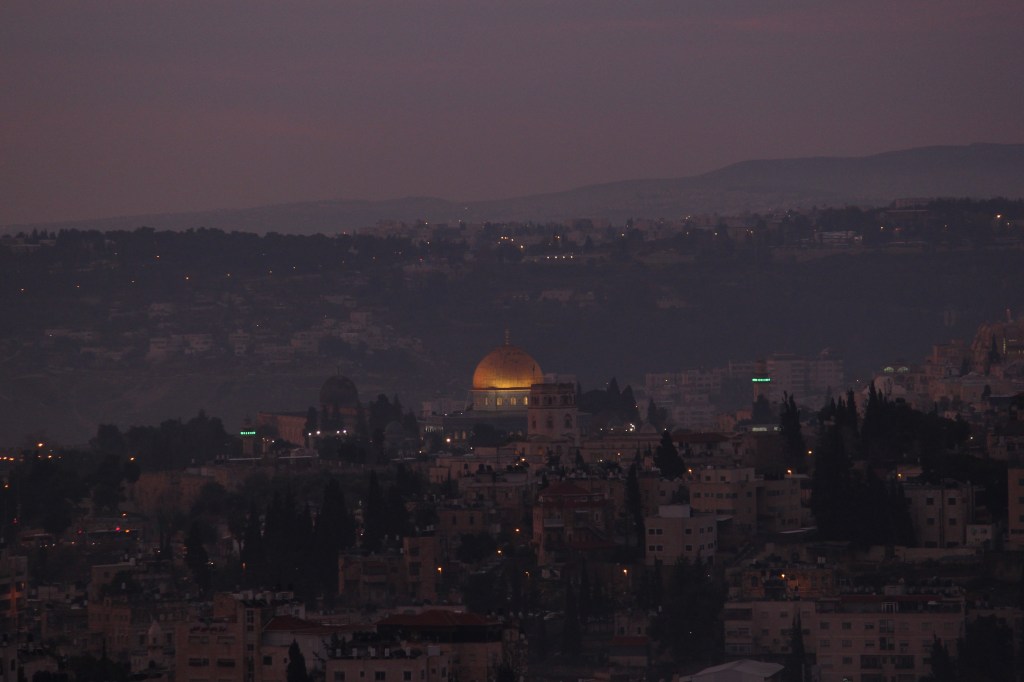
I don’t know how long I was gazing over the skyline of a sleeping city. All I knew was the sky opened into a silent pinkish haze and the Dome of the Rock was a regal jewel that stood amongst a grey garden. A single beacon of beauty and light all through the long night. Every night.
People. It’s the people that make the city. A city without people is just faceless walls all staring at each other with no way of communicating. It’s the people that spark the flame and the people that keep it going. Without the people, the city fades into concrete jungle, the littered remnants of something, someone, sometime. It’s the people they are fighting for. My people, as my lecturer had put it. His people. People were the culture and the culture is why I was here. I had come to learn the history, to study it and understand what it was about that city that had been the face of so many horrors, yet still survived, scarred and all. What still drew attention as the centre for religious culture in the world. The people were the creators. I was just an outsider that had the pleasure to look in and take part in their story of which I now occupy a page.
Jerusalem
 Writer and Photographer Alexander S.W.